Part comedy and part horror, Hot Dog Hands by Matt Reynolds is a squiggly little story involving bullying and body issues.
A woman (Gillian Wallace Horvat) becomes a recluse when her hands sprout plump fingers that look like hot dogs — and they won’t stop. The boys on her street notice; they stand in a group outside her house and chant, “Hot dog hands!” It’s upsetting to say the least.
A piece of junk mail leads the woman to a cure, but it’s not what she (or I) expected. It’s a weird but cute and kind of sweet solution that made me smile. Stuck between features of a horror movie marathon during the wee hours of the morning, it also gave me a jolt of energy that perked me up and allowed me to move onto the next film awake. Bravo!
For some reason — I can’t find an answer — Il Boom was not released in the States until this year. Madonne! Better late than never, and I’m glad it made it because it reaffirms my love of midcentury Italian cinema.
Giovanni Alberti (Alberto Sordi) lives large. His fabulously modern apartment in Rome features a gorgeous patio for entertaining. He employs a housekeeper and sometimes a wait staff. His beautiful and frivolous wife, Silvia (Gianna Maria Canale), has expensive taste. Every night, they go out on the town for lavish dinners and fancy cocktails, dancing and partying in the most chic and trendy clubs.
A game of footsie under the table suggests that his bourgeois crowd is into some naughty stuff on the side, but Giovanni loves Sylvia way too much for that.
Life is grand, but that’s the problem: Giovanni lives above his means. Unbeknownst to Sylvia, who continues to spend gleefully, he’s over his head in debt and about to be publicly humiliated on “the registry.” He can’t get another loan because his credit is shot. Desperate, he suggests a simpler lifestyle, which Sylvia simply ignores. He can’t bring himself to tell her why.
Giovanni fails miserably to convince a number of friends and associates to invest in his land development plan, which may or may not be a scam. His last hope is one-eyed real estate mogul Mr. Bausetti (Ettore Geri), who like everyone else turns him down. Mrs. Bausetti (Elena Nicolai), however, makes a proposal behind her husband’s back: she offers to buy Giovanni’s left eye. He can name his price.
Il Boom is a lot of fun. The title refers to the postwar economic boom in Italy and elsewhere. Director Vittorio De Sica and writer Cesare Zavattini are critical of consumerism, and there’s definitely a moral. However, they avoid getting on a soapbox and simply make fun of it. The story moves along breezily, and quite a few scenes — the dinner party, the hospital — are memorably offbeat and funny. Sordi is perfect as the hapless Giovanni, displaying a mercurial energy and general uneasiness that keeps you watching. His reaction to Mrs. Bausetti’s offer is priceless. I left with a smile.
Armando Nannuzzi’s cinematography is beautiful in luminous black and white; I can’t imagine Il Boom in color. Billy Vaughn’s super cool “Wheels” plays throughout the film; man, does it stick in your head. I’m humming it now.
With Alceo Barnabei, Federico Giordano, Antonio Mambretti, Silvio Battistini, Sandro Merli, John Karlsen, Ugo Silvestri, Gloria Cervi, Gino Pasquarelli, Maria Grazia Buccella, Mariolina Bovo, Felicita Tranchina, Franco Abbiana, Rosetta Biondi
“Relax. Your daughter’s perfectly fine in my hands.”
— Moonee
Sean Baker’s Tangerine (https://moviebloke.com/2015/07/28/tangerine/) impressed me. On the surface an offbeat odyssey of castoffs living on the fringe in West Hollywood, it’s one of those films that creeps up and hits you at the end. Comprised largely of small moments and vignettes strung together, its sum is much more — and completely different — than its parts: insightful, powerful, and quietly profound.
I was thrilled to hear that Baker has a new film, The Florida Project, out this fall. The comments I overheard from audience members while walking out of a prerelease screening were amusing but maddening: “That was realism, hard realism. Too hard.” “Well, that didn’t go anywhere.” “I had to force myself to stay awake.” “I wouldn’t recommend that to anyone.” Insert eyeroll here.
I disagree. The Florida Project switches gears, so it doesn’t end up where it seems to be going. The trailer makes it look like a childhood nostalgia movie, and it starts out like one. But it’s not. Often amusing but just as often difficult to watch, it paints a vivid picture that doesn’t criticize, demean, or sentimentalize its characters or their situation. I’ve heard Baker lauded for his humanism; his work definitely shows plenty of that if nothing else. His best attribute may be his willingness to let his characters develop into real people over the course of two hours or so.
To be clear, the impact of The Florida Project is not immediate. Baker’s pace isn’t quick, either. Written by Baker and Chris Bergoch, The Florida Project starts out as a sort of Little Rascals sitcom involving the misadventures of besties Moonee (Brooklynn Prince) and Scooty (Christopher Rivera), two grade school kids growing up in a sketchy roadside motel, the Magic Castle, that sits along a tawdry strip just outside the Magic Kingdon — a.k.a. Disney World in Orlando. A gun shop, a convenience store, a market that sells oranges, and a boarded up clinic dot the strip, which incidentally intersects with Seven Dwarves Lane.
Moonee and Scooty spend their days running around, screaming, and stirring up mischief. They spit all over a motel guest’s car. They drop water balloons on people. They spy on an elderly topless sunbather (Sandy Kane). They scam change to buy ice cream. They set a fire. They recruit a third hellion, Jancey (Valeria Cotto), who lives next door and easily goes along with their antics probably because there’s no one else to play with. Their favorite target is weary motel manager Bobby (Willem Dafoe).
Slowly, a different picture emerges and The Florida Project becomes another film. Moonee’s mother, Halley (Bria Vinaite), can’t get it together. Feral and clearly her own worst enemy, she lives hand to mouth with her young daughter. She’s constantly about to be evicted, and she takes free meals wherever she can get them. When selling stolen amusement park passes and wholesale perfume in the parking lot of a “nicer” motel up the street doesn’t work, she turns tricks in the room.
After Halley has a falling out with Scooty’s mom, Ashley (Mela Murder), Baker literally zooms in on Moonee.
The events here are purposely mundane, and it’s hard to say exactly where the climax is. It doesn’t matter: The Florida Project works because of the way Baker executes the story. He’s just as careful about choosing what he shows as what he doesn’t. The thrill here is watching the characters develop, anyway; that’s what makes The Florida Project soar. It doesn’t hurt that the acting is superb, particularly Vinaite, Prince (who at six years old is a natural — I almost cried when she did), and Dafoe, whom I haven’t seen this good since Mississippi Burning.
Alexis Zabe’s cinematography — alternating long shots and pans with almost uncomfortably close shots — works beautifully with the gorgeously effervescent color palette. The ending is unexpectedly touching and fun. The Florida Project just might be the first Oscar contender I’ve seen this year.
With Josie Olivo, Aiden Malik, Caleb Landry Jones, Shail Kamini Ramcharan, Sonya McCarter, Karren Karagulian, Kelly Fitzgerald, Lauren O’Quinn, Edward Pagan, Cecilia Quinan, Kit Sullivan, Andrew Romano
Production: Cre Film, Freestyle Picture Company, June Pictures, Sweet Tomato Films
Distribution: A24 (USA), Altitude Film Distribution (UK), Elevation Pictures (Canada), Filmcoopi Zürich (Switzerland), September Film (Netherlands), Front Row Filmed Entertainment (United Arab Emirates)
“Eating blood? Do you think I’ve ever written down ‘eating blood’ before? Where am I?”
— Bishop Bartolomeo
From what I remember in my English lit classes, Geoffrey Chaucer called it as he saw it. He took a dim view of piousness and devotion because he knew that neither makes someone a good person. Hold that thought.
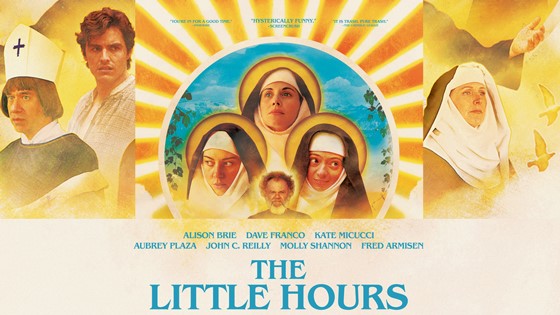
Some people take religion very seriously. Others reach such a high level of intellectual refinement or maturity that it puts them beyond crass, juvenile humor. Good for them — I’m not one of those people. I adore a snarky, irreverent story; it’s even better when it involves absurdism or sacrilege and still has something to say. The Little Hours is exactly that: a farce with a point.
Set during the Middle Ages, hapless Fr. Tommasso (John C. Reilly) has the unenviable job of overseeing a convent. Yipee. He finds himself without a gardner when Lurco (Paul Weitz) quits after three hateful young nuns — vain Sr. Alessandra (Alison Brie), nerdy gossipry Sr. Ginerva (Kate Micucci), and belligerent Sr. Fernanda (Aubrey Plaza) — physically attack him one too many times.
While on a mission selling embroidery to raise funds for the convent, Fr. Tommasso, lost and drunk, crosses paths with Massetto (Dave Franco), a servant running from his master, obnoxious douchebag Lord Bruno (Nick Offerman). Bruno is out for blood (not to mention balls) after he discovers Massetto has been carrying on with his wife (Lauren Weedman) for some time.
Fr. Tommasso learns of Massetto’s dilemma and makes a proposal: Massetto can work in the garden at the convent, but he must pose as a deaf-mute to avoid stirring the ire of the nuns. Massetto accepts, but things don’t pan out quite as intended. The young nuns are, well, horny. Not long after he arrives at the convent, Massetto is getting it on with both Alessandra and Fernanda. All hell breaks loose when they find out.
Written and directed by Jeff Baena, The Little Hours is loosely based on — or a spoof of — a novella from Giovanni Boccaccio’s The Decameron, a 14th Century epic. If this sounds highbrow, don’t fret — it’s the only sophisticated thing about this film, which is fine because it is above all else a comedy.
Loaded with f-bombs, sex, and general malice, The Little Hours is an amusing mix of Mean Girls and Monty Python. The cast works well as an ensemble, bringing out and playing off of each other’s goofiness in an endearing way. I see hints of improvisation, which brings even more energy to the whole thing. Although the story peters out toward the end, Baena keeps the momentum going strong for most of it. What could have been a thin joke stretched out too long and too far stays fresh and fun with this vibrant and funny cast.
For all its silliness and flippancy — pretty much all seven deadly sins make an appearance here — Baena raises an interesting point. The Little Hours is very much a comedy about desire, and it get its laughs from the conflict between desire and appearance. Without getting preachy, The Little Hours shows that piousness and devotion don’t douse the flames of desire; sometimes, they fan them. After all, we’re all merely human. I can’t help thinking that Chaucer would approve.
With Molly Shannon, Fred Armisen, Jon Gabrus, Jemima Kirke, Adam Pally, Paul Reiser
Good Time is not a film to see for the plot. Written by Josh Safdie and Ronald Bronstein, the storyline is not all that novel, complicated, or interesting — in itself. I can sum it up in a single sentence: Queens bad boy Connie Nikas (Robert Pattinson) spends a night fleeing cops while trying to get his mentally handicapped younger brother, Nick (Benny Safdie), out of the mess he put him in after a bank robbery they commit goes sideways. It sounds like a comedy, but it most definitely is not.
Good Time is a movie to see for the mood it creates — and man, is it intense! More or less a character study, this could have been a disaster in someone else’s hands. As it is, the whole thing soars thanks to the directing by brothers Benny and Josh Safdie and the acting, which is all around great. Pattinson is particularly terrific — forget Twilight. I’ve heard comparisons to Al Pacino’s best work in the ’70s, and I’ve got to agree; Pattinson conveys a natural nervous energy just under the surface so well that you feel it watching him. I found myself more and more jittery and paranoid with every move and bad decision Connie makes and every character he encounters. I noticed hints of Dog Day Afternoon, Cruising, The Godfather, and even The Graduate in Pattinson’s performance.
Taking place almost entirely at night, the settings are familiar but eerie: a hospital, the crammed TV-lit apartment of a Jamaican immigrant (Gladys Mathon) and her weed smoking teenage granddaughter (Taliah Webster), an empty amusement park. Add a skittish techno score by Oneohtrix Point Never, a pallet of neon-colored light, and a nonstop chase, and you’ve got Good Time. Roller coaster ride or drug trip, take your pick — either way, this is a film that drags you along for the ride and zaps you, in a really satisfying way. I don’t know if Good Time is Oscar material, but it’s definitely memorable.
I almost missed Good Time, which opened for what appeared to be a very short limited run in Chicago. I made my own bad decision to see it Friday night after dinner with lots of cocktails. The film became a big blur that my drunk brain couldn’t handle. I went back for a Sunday matinee by myself. I left impressed, and actually pissed that I wasn’t present the first time I caught it.
With Jennifer Jason Leigh, Barkhad Abdi, Necro, Buddy Duress, Peter Verby, Saida Mansoor, Eric Paykert
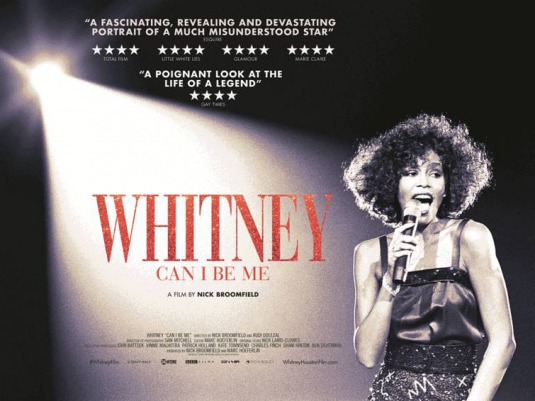
Whitney Houston certainly needs no introduction, and I don’t need to remind anyone about her drug-fueled decline or her sad death five years ago. I saw her perform once when she toured for her first album, but I was never a fan. Still, I observed her career from the sidelines and know all her hits (and misses). To borrow from one of her songs, she almost had it all. Almost.
For better or for worse, Broomfield, who shares a directing credit with Rudi Dolezal for his footage from Houston’s 1999 My Love Is Your Love World Tour, takes a decidedly conventional and low key approach here. He eschews TMZ-like sensationalism, which is refreshing, even admirable. However, the finished product rings incomplete.
Broomfield shows Houston’s dirty laundry. We learn that she used drugs from adolescence. She wasn’t particularly polished. Her mother pushed her, hard. Her label, Arista, had a grand plan for her, and it specifically excluded drawing a black audience. Her BFF Robyn Crawford, who stayed involved with Houston’s career until the aforementioned 1999 tour, was (and still is) a lesbian, which led to rumors. Houston and Bobby Brown were in love, but it didn’t stop him from cheating on her — apparently, he preyed on Houston’s entourage. Crawford and Brown didn’t get along, which created tension. There was also that thing with Houston’s father that happened at the end of his life.
We gets hints and glimpses of what led to Houston’s downfall, but in the end the whole thing is shallow. Like her image throughout her career, Whitney: Can I Be Me? presents a sanitized or at least downplayed picture. Broomfield could’ve dug deeper. He was getting there with Houston’s former bodyguard, David Roberts, who claims that he was repeatedly ignored when he warned everyone around her that Houston was on a fatal trajectory. This documentary falls short; it’s flat and has nothing, shall we say, so emotional. It doesn’t reveal all that much. As a result, it isn’t all that moving.
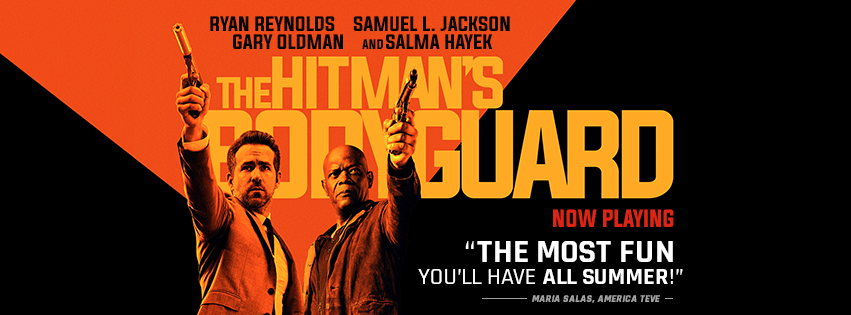
“Get Triggered,” commands one of the movie posters for Patrick Hughes’s The Hitman’s Bodyguard. I don’t know what that means here, but this film is a bit fluffy to trigger much more than some chuckles — after all the eyerolling, of course. That’s how it went for me.
Ryan Reynolds is Michael Bryce, a humiliated professional bodyguard whose career took a hit — get it? — after a client (Tsuwayuki Saotome) was shot and killed right in front of him. Now, he barely ekes out a living guarding low profile corporate executives addicted to speed. He operates out of his run down car, which is where he also lives (as evident from his “bathroom,” an empty water bottle). To make matters worse, Michael is still reeling from a breakup with Amelia (Élodie Yung), an Interpol agent he blames for his sad state.
Amelia is charged with a simple but very consequential mission: to deliver notorious hitman Darius Kincaid (Samuel L. Jackson) to the International Court of Justice at the Hague. Darius has agreed to testify against Vladislav Dukhovich (Gary Oldman), the depraved dictator of Belarus on trial for crimes against humanity. Unfortunately for the prosecution, Dukhovich has a stalwart and invincible army of goons that hunts and kills any witness who has any dirt on him. Darius is the prosecution’s last hope, and the clock is ticking.
When Amelia’s armored car is attacked by Dukhovich’s men, she and Darius go into hiding. She contacts Michael for a favor: to complete the mission and get the star witness to the Hague. She doesn’t tell him who the witness is, and it turns out that Michael and Darius have a history. It ain’t pretty.
Not surprisingly, The Hitman’s Bodyguard is light fare, a stock comedy/action quasi buddy flick. It’s a perfect summer movie; frankly, I’m not sure why it wasn’t released earlier. Tom O’Connor’s screenplay is repetitive, predictable, and loaded with F-bombs, but it’s fun and isn’t at all serious. Reynolds and Jackson have an amusing love/hate relationship filled with banter about everything from murder to love to pop music that wouldn’t be out of place in Pulp Fiction. In between their banter is nonstop action — car chases, explosions, shoot outs in helicopters and boats, cat and mouse games.
Jackson does what he does best: causes grief and cusses with force. Reynolds plays a good square with earnestness. If these two had better chemistry, The Hitman’s Bodyguard would be a more memorable film. Salma Hayek is the best thing about this movie: she’s dramatic and severe and hilarious as Sonia Kincaid, the streetwise but still crazy wife of Darius. Rotting away in an Amsterdam prison, she’s relentless about protesting the grave injustice done to her. She effortlessly steals every scene she’s in.
With Michael Gor, Tine Joustra, Yuri Kolokolnikov, Rod Hallett, Joaquim de Almeida, Kirsty Mitchell, Richard E. Grant
I have mixed feelings about Christopher Nolan’s spectacular Dunkirk, a World War II military drama that has very little to do with battle. Told from three perspectives — land (“the mole”), sea, and air — the story here centers on an evacuation, that of British and allied soldiers from the beaches of Dunkirk, a fishing village in northern France at the Belgian border, over a ten-day period in late Spring 1940 (https://en.wikipedia.org/wiki/Dunkirk_evacuation).
I have to admit ignorance here: I knew nothing about the Dunkirk evacuation going into this film. Nolan doesn’t spend any time on background or what led to this point; instead, he just picks up with British soldier Tommy (Fionn Whitehead) fleeing German fire outside the beach. I wish I had known ahead of time because I would have done some research. I thought a better job could have been done telling the story.
The structure, jumping between the three perspectives, takes a little work to follow. What exactly is going on is unclear and confusing, and it creates a nice sense of claustrophobia and panic in many scenes — especially that boat scene. This is good. However, keeping track of the characters is a tough task not made any easier by giving all the soldiers the exact same black hair dye. I found it hard to relate to or care much about any of them because I was kept at arm’s length. I couldn’t get invested. While definitely not the same story, Dunkirk is a kind of a big budget Son of Saul — just not as good.
As a spectacle, though, Dunkirk is magnificent. Cinematographer Hoyte van Hoytema shot it on 70 millimeter film, and he packs this picture with gorgeous wide shots of the beach, the sea, and throngs of desperate soldiers. He beautifully captures the hopelessness of the situation with a drab palette of only a few army colors: greens, greys, blues, and cold whites that convey a chill I could see and feel. The sound is over the top loud. If nothing else, Dunkirk is total sensory overload. It’s worth seeing for that alone.
Side note: I’m not sure which is the bigger surprise here — that 1D’s Harry Styles actually isn’t terrible, or that Tom Hardy is hidden under aviator goggles for the entire film. The latter is a bummer. He’s so hot!
With Mark Rylance, Tom Glynn-Carney, Jack Lowden, Aneurin Barnard, James D’Arcy, Barry Keoghan, Kenneth Branagh, Cillian Murphy, Michael Caine
Production: Syncopy, Warner Brothers, Dombey Street Productions, Kaap Holland Film, Canal+, Ciné+, RatPac-Dune Entertainment
Distribution: Warner Brothers, Karo Premiere (Russia), NOS Audiovisuais (Portugal), Roadshow Entertainment (New Zealand), Roadshow Films (Australia)
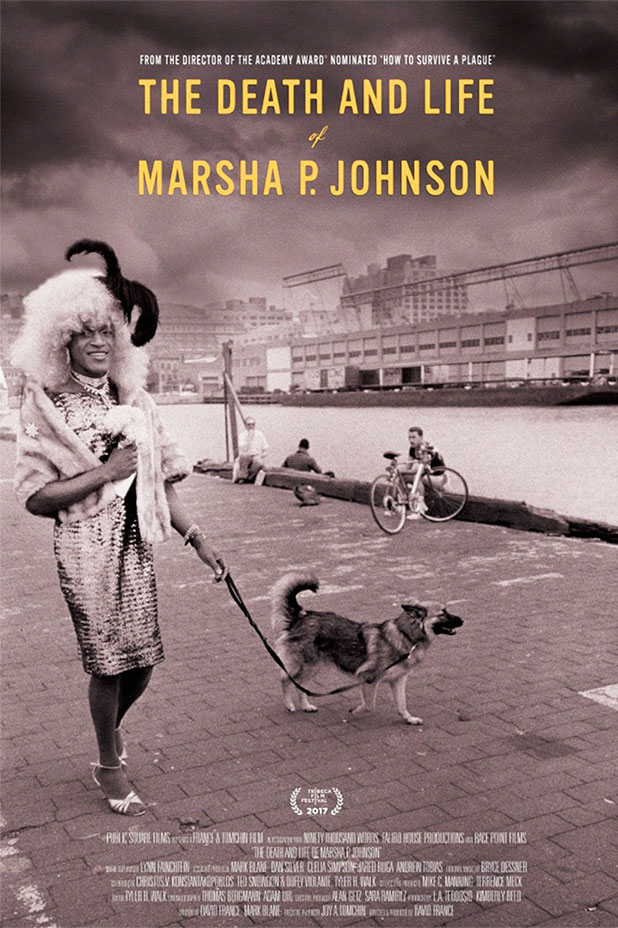
Marsha, Marsha, MARSHA! I’ll say this: David France’s new documentary has a lot going on in it. The center of the film, obviously, is legendary Greenwich Village “street queen” Marsha P. Johnson, a trans LGBT activist who hit the streets and stood at the front line when the fight was just about the “gay rights” movement. In the ’60s. Marsha, a figure at the Stonewall riots, founded Street Transvestites Action Revolutionaries, or S.T.A.R., with Sylvia Rivera in the early ’70s — 1970 to be exact. Her fight continued onto AIDS and transgender issues. She clearly was ahead of her time.
Sadly, Marsha ended up in the Hudson River in 1992, an apparent murder victim. It was almost 25 years to the date that I saw this film. The New York City Police Department called it a “suicide” — then called it a day. It remains an unsolved case.
The Death and Life of Marsha P. Johnson wants to honor Marsha, and it kind of does. At the very least, it sings her praises and puts her in a positive light. Ultimately, though, it fails. Told through the eyes of friend and surrogate Victoria Cruz, it unfortunately lets other things — mainly other people’s egos — get in the way. Part history and part true crime, Marsha’s story is watered down because French crams in more than what’s necessary to tell it, and he loses her in the process.
The Death and Life of Marsha P. Johnson succeeds in showing Marsha’s determination and influence. Perhaps unintentionally, it also shows a wonderfully colorful version of New York City in its cultural — or countercultural — prime, a place that simply doesn’t exist anymore. The hardest part of watching this film, though, is the attitude against trans people — even from gay men. It’s something you might not expect, but there it is.
From a historical or social standpoint, this is a winner. As far as Marsha is concerned, it could have been better. Still, it’s worth the time it takes to see it.
With Michael Baden, Frances Baugh, Pat Bumgardner, Jimmy Camicia, Eddie DeGrand, Matt Foreman, Jacques Garon, Chelsea Goodwin, Xena Grandichelli, Jennifer Louise Lopez, Agosto Machado, Marcus Maier, Ted Mcguire, Jean Michaels, Robert Michaels, Rusty Mae Moore, Candida Scott Piel, Coco Rodriguez, Kitty Rotolo, Vito Russo, Mark Segal, Beverly Tillery, Randy Wicker, Brian R. Wills, Sue Yacka
Production: Public Square Films, Faliro House Productions, Ninety Thousand Words, Race Point Films, Terasem Media & Films
Distribution: The Film Collaborative, Netflix
Screening introduced by David France and followed by a live Q and A with France, Mark Blane, and someone whose name I didn’t catch moderated by Alonso Duralde
Ulysses (Luka Kain) is a quiet, delicate teen who lives in Queens and is just starting to figure out his sexual identity — it involves wearing panty hose under his jeans. When his father dies, he becomes the “man of the house.” Unfortunately, his mother (Margot Bingham), who works all the time, is already on edge because she caught him wearing her clothes. Ulysses shares a bedroom with his younger brother, Abe (Jaylin Fletcher), who knows that he’s still rummaging through mom’s closet on the sly and gives him shit for it. School is no respite because Ulysses’s classmates are jerks.
Enter stern Aunt Rose (Regina Taylor) to help at home while mom is away at work. She takes charge, usurping Ulysses and his mother as the master of the domain. She’s not about to have a dress-wearing freak around, so she pushes Ulysses toward the one cure she knows: the Lord.
Ulysses escapes to the Christopher Street Pier, where he meets a gang of “drag queens”: Ebony (MJ Rodriguez), Dijon (Indya Moore), and Heaven (Alexia Garcia). They take him to “Saturday Church,” a space in Greenwich Village where one night a week trans mother hen Joan (Kate Bornstein) offers a meal, a shower, clothes, perhaps a spot to vogue, and companionship to homeless LGBTQ kids. This is where Ulysses finds his groove.
Too bad mean Aunt Rose is waiting for him to come home.
Damon Cardasis’s first feature length film is a winning mix of Moonlight (https://moviebloke.com/2016/11/19/moonlight/ ), La La Land (https://moviebloke.com/2016/10/13/la-la-land/ ), and Tangerine (https://moviebloke.com/2015/07/28/tangerine/ ) with just the right splash of Paris is Burning (https://moviebloke.com/2016/08/26/paris-is-burning/ ). Saturday Church has some shortcomings, but the film oozes so much charm and warmth that I found it easy to forgive its flaws. Some of the songs and dance numbers are better than others — the song in the locker room and the other with Ulysses singing to his new boyfriend (Marquis Rodriguez) as they walk to the train stand out, especially when flower petals start falling. It’s really cool.
The acting is really good all around, but Kain is particularly awesome. He gives palpable tenderness and vulnerability to his character. The so called “drag queens” are not just fierce but downright touching. The way they save Ulysses is sweet. They make you long for a friend who has your back like they do. The story here totally sold me. I look forward to what’s next from Cardasis.
With Stephen Conrad Moore, Peter Y. Kim, Evander Duck Jr.
Production: Spring Pictures, Round Films
Distribution: Samuel Goldwyn Films
Screening introduced and followed by a live Q and A with Damen Cardasis









 moviebloke