My Friend Dahmer

(USA 2017)

“You don’t have to suffer to be a poet,” said writer John Ciardi. “Adolescence is enough suffering for anyone.” Even the most notorious evildoer was once just a kid, and infamous cannibal serial killer Jeffrey Dahmer is no exception. My Friend Dahmer portrays him as a gawky teenage reject struggling to find a place where he fits.

Bath, Ohio, in the mid-1970s: young Jeff (Ross Lynch) is a high school freshman who lives with his parents, chemist Lionel (Dallas Roberts) and Joyce (Anne Heche), and his little brother, Dave (Liam Koeth). It’s a normal middle class nuclear existence, except for his mother’s mental illness, his parents’ bickering, and his odd pastime of collecting roadkill and dissolving the carcasses in a vat of acid his father gave him. There’s also his obsession with a rather bearish jogger (Vincent Kartheiser) Jeff frequently sees running past his house.

Jeff’s not making it at school, where his classmates look past him, probably because he’s so fucking weird. Out of apparent fearful concern for his loner son, Lionel demands that Jeff make some friends after he discovers a collection of bones stashed away in Jeff’s hideout in the woods.

Jeff fakes an epileptic seizure in the cafeteria at school and attracts the attention of Derf Backderf (Alex Wolff) and his friends, Neil (Tommy Nelson) and Mike (Harrison Holzer), who get a kick out of him and his antics. They start hanging out with Jeff and form “The Jeffrey Dahmer Fan Club,” a front for pulling pranks because they can get Jeff to do anything — even finagling a meeting with Vice President Walter Mondale (Tom Luce) on a class trip to Washington, D.C.

Jeff seems to be connecting to others for the first time, but his disintegrating home life throws off his progress.

Adapted from Cleveland artist Derf Backderf’s graphic novel, screenwriter and director Marc Meyers eschews gore and focuses on psychology, examining what may have happened to send Dahmer where he ended up. His approach is surprisingly empathetic and understanding without making excuses. Backderf offers unique insight that Meyers uses wisely. The acting, particularly that of Lynch and Wolff, lends a sensitivity that initially might seem unwarranted if not unworthy of the subject. The story here is sad, really: no gore, no murders, just a weird kid whose home life is falling apart.

My Friend Dahmer is a mix of teen comedy and tragedy that ends immediately before his first murder. It’s much better than I anticipated.

With Adam Kroloff, Brady M.K. Dunn, Michael Ryan Boehm, Cameron McKendry, Jake Ingrassia, Ben Zgorecki, Kris Smith, Jack DeVillers, Gabriela Novogratz, Miles Robbins, Joey Vee, Susan Bennett, Maryanne Nagel, Andrew Gorell, Katie Stottlemire, Carmen Gangale, Sydney Jane Meyer, Dave Sorboro, Denny Sanders

Production: Ibid Filmworks, Aperture Entertainment, Attic Light Films

Distribution: FilmRise, Altitude Film Entertainment

107 minutes
Rated R

(Gene Siskel Film Center) B

http://www.myfrienddahmerthemovie.com/#1

Lady Bird

(USA 2017)

“You should just go to City College. You know, with your work ethic, just go to City College and then to jail and then back to City College. And then maybe you’d learn to pull yourself up and not expect everybody to do everything.”

— Marion McPherson

“Lady Bird always says that she lives in on the wrong side of the tracks, but I always thought that that was like a metaphor, but there are actual train tracks.”

— Danny

“You’re going to have so much unspecial sex in your life.”

— Kyle

Lady Bird is not Greta Gerwig’s first time directing; she codirected an earlier film, Nights and Weekends, in 2008. I never heard of that one. However, Lady Bird is her first solo gig, as well as her first hit. I wanted to catch it at the Chicago International Film Festival, but it was impossible to get tickets.

I’ve now seen it in its commercial release. Saoirse Ronan is Christine McPherson, an angsty, unpopular, and rather nerdy but self-assured Catholic high school senior who’s christened herself “Lady Bird.” She lives in a modest home literally “on the wrong side of the tracks” with her parents, her underachiever older brother (Jordan Rodrigues) who graduated from a “good” university but still works as a cashier in a grocery store, and his wife (Marielle Scott).

Christine wants a bigger life than the one she has in Sacramento, and she plans to get it by going away to college. Her perpetually crabby mother (Laurie Metcalf) is not exactly supportive, and her disposition gets worse when her father (Tracy Letts) loses his job.

Set in 2002, Lady Bird is a string of funny and touching episodes about growing up in a lower middle class Catholic home: sex, fitting in, rebellion, and of course Catholicism. I laughed out loud, and did so a lot. Gerwig wrote and directed it, and it’s a solid film even it rings a little familiar. She’s more observant of her characters’ behavior than creating some big dramatic experience. Lady Bird is structured like a lot of teen comedies I’ve seen before, but the acting is good enough to elevate it to a higher level and make it a bit more interesting. More adult, too.

As some friends have pointed out, the main character — Christine — is a refreshing break from the Hollywood archetype of a teenage girl we’ve all seen for more than 30 years now: she’s not a mean girl, a witch, or a slut. This is true, and a big plus here. Still, as much as I enjoyed Lady Bird, I don’t get the awards buzz over it.

With Danny O’Neill, Timothée Chalamet, Beanie Feldstein, Lois Smith, Stephen McKinley Henderson, Odeya Rush, John Karna, Jake McDorman, Bayne Gibby, Laura Marano, Fr. Paul Keller, Myra Turley, Bob Stephenson, Joan Patricia O’Neill, Carla Valentine, Roman Arabia

Production: Scott Rudin Productions, Entertainment 360, IAC Films

Distribution: A24 (USA), Elevation Pictures (Canada), United International Pictures (UIP) (international), Universal Pictures International (UPI) (international)

94 minutes
Rated R

(Landmark Century) B

http://ladybird.movie

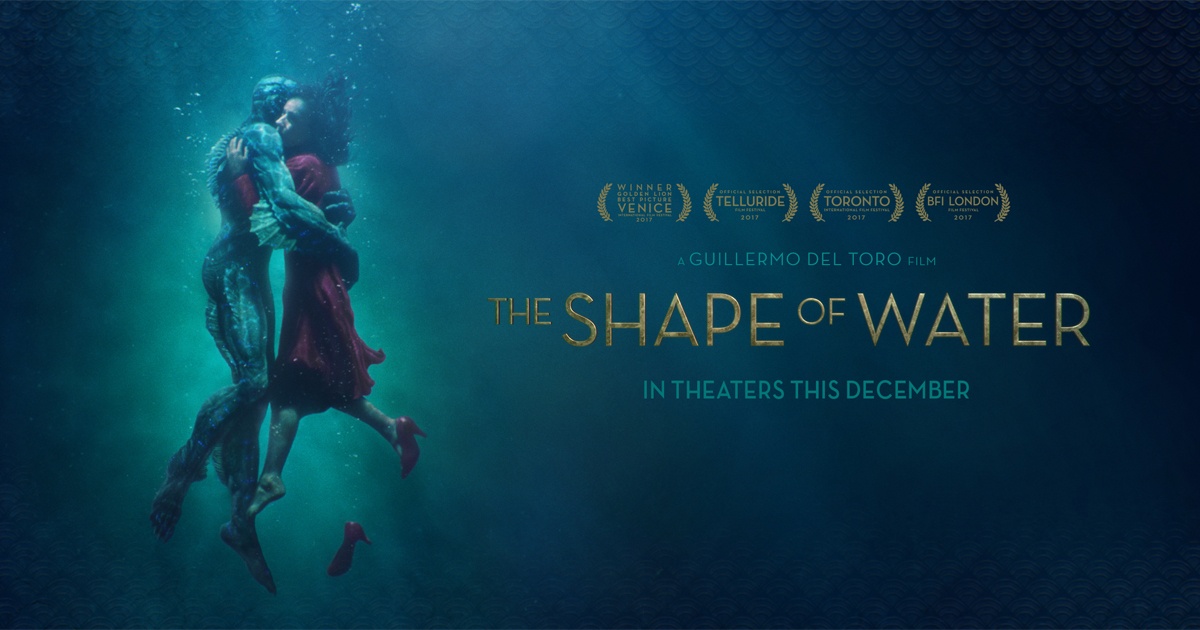
The Shape of Water

(USA 2017)

“The natives in the Amazon worshipped it like a god. We need to take it apart. Learn how it works.”

— Strickland

I knew only two things walking into The Shape of Water: one, Guillermo del Toro directed it; and two, one of the characters is a sea creature. I expected a dark and fantastical fable with del Toro’s trademark look and feel all over it.

I was right about everything except this being dark; the world where the story is set may be sinister and the color palette may be Cold War drab, but The Shape of Water is an uncharacteristically sweet departure for del Toro, at least what I’ve seen from him.

Set in 1962 Baltimore — far dimmer than the one in the John Waters classic Hairspray — Elisa (Sally Hawkins) is a mute single lady who quietly exists on the fringes. She rents a rundown apartment above a movie theater and works as a janitor in a high-security government laboratory tucked away in a complex somewhere outside town. Her only connections to the world are Giles (Richard Jenkins), her aging homosexual next door neighbor, and Zelda (Octavia Spencer), a coworker who acts as her interpreter.

Elisa is drawn to a scaly amphibian (Doug Jones) dragged from the Amazon and kept inside a water tank in the lab where she works. She can’t stand the way Strickland (Michael Shannon), a wreckless government agent, treats him. She forges a bond with the creature, feeding him hard boiled eggs on the sly. He grows to trust her, proving to be a gentle soul under all those scales.

Elisa gets wind of what Strickland has in store for the creature — over the objections of Dr. Hoffstetler (Michael Stuhlbarg), a marine biologist who tries to dissuade him. Strickland insists. Elisa takes matters into her own hands to save the poor thing.

Written by del Toro with Vanessa Taylor, the screenplay isn’t as dark, intense, or innovative as, say, Pan’s Labyrinth. Nevertheless, it’s got its charm. The Shape of Water is sexually charged, which is interesting (and frankly pretty funny at one point). The story, a romance, is much sweeter than what I tend to go for. The plot elements are familiar: outcasts, forbidden love, a maniacal plan in the name of science, a dangerous rescue, a fish out of water (literally), even a bit of espionage. It all comes together in a magnificently magical if not exactly unexpected finale.

Del Toro’s execution is what makes this film soar. Visually, he recalls Marc Caro and Jean-Pierre Jeunet (The City of Lost Children and especially Delicatessen). His use of color is clever and often seductive, even with a lot of brown and grey. The amphibian’s costume is cool, straight out of Pan’s Labyrinth (those eyes).

I love the references to other films — Creature from the Black Lagoon, E.T., King Kong, Beauty and the Beast, The Hunchback of Notre Dame. An astute friend of mine posits that the real love story here involves movies, with all of us mute viewers who fall for the fantastic. I find his interpretation to be the best I’ve heard.

The Shape of Water seems to be a polarizing film, moreso than any other I can think of this year; some of those I’ve talked to loved it, others hated it — with a passion. I fall into the former category. I can see myself coming back to this one from time to time.

With David Hewlett, Nick Searcy, Stewart Arnott, Nigel Bennett, Lauren Lee Smith, Martin Roach, Allegra Fulton, John Kapelos, Morgan Kelly, Marvin Kaye, Dru Viergever, Wendy Lyon, Cody Ray Thompson, Madison Ferguson, Jayden Greig

Production: Bull Productions, Double Dare You (DDY), Fox Searchlight Pictures

Distribution: Fox Searchlight Pictures (USA), 20th Century Fox (International), Hispano Foxfilms S.A.E. (Spain), Big Picture 2 Films (Portugal), Centfox Film (Austria), Forum Hungary (Hungary), Odeon

123 minutes
Rated R

(ArcLight) B+

http://www.foxsearchlight.com/theshapeofwater/

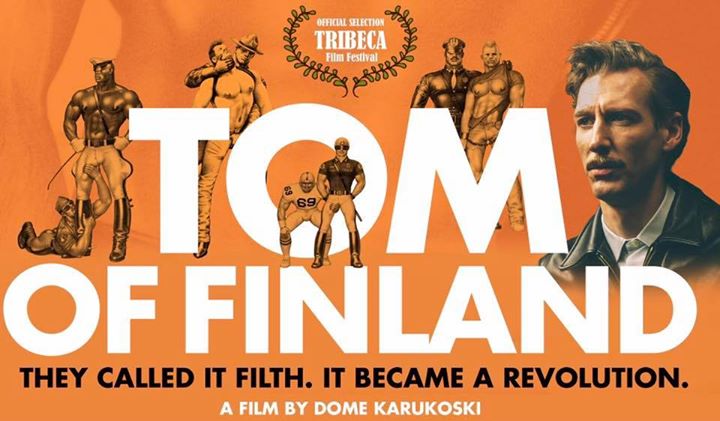
Tom of Finland

(Finland / Sweden / Denmark / Germany / USA 2017)

Touko Valio Laaksonen, a.k.a. Tom of Finland, was extraordinary and unconventional. Dome Karukoski’s rather vanilla biopic Tom of Finland is neither.

With Aleksi Bardy’s screenplay, Karukoski lays out a good historical background of the life of the artist, whom Pekka Strang plays convincingly enough, at least until Tom’s later years. The story takes us through WWII, where Tom serves as a closeted solder in the Finnish army and catches the eye of his sargeant (Taisto Oksanen), into his postwar life in conservative Helsinki, where he works as an advertising illustrator, cruises public parks at night (and evades arrest), and sketches “dirty” homoerotic fetish doodles in his spare time. He shares an apartment with his homophobic sister (Jessica Grabowsky), which provides much of the dramatic tension in this story, especially when a cute boarder, dancer Veli (Lauri Tilkanen), moves in. Ultimately, the story leads to 1980s Los Angeles.

For a subject who really pushed the envelope — okay, he rammed it somewhere else altogether — and left his mark, Tom of Finland is a disappointingly conventional, even sappy biopic. The focus is on Tom’s personal struggle to live his life ‘out,’ which is a fine angle. Aside from a scene involving a Russian paratrooper (Siim Maaten) that apparently had a profund effect on Tom, however, Karukoski doesn’t delve deep enough to offer much insight; he seems to want to give an intimate picture but somehow stays at arm’s length from his subject. Too bad. His references are good but his approach is more documentarian or downright clinical. He skips huge chunks of time, which makes for awkward transitions in the film’s latter half. More frustratingly, he starts to raise some interesting points about art, conformity, AIDS, community, and longevity, but opts not to go there. Tom of Finland could have been a much more interesting film.

With Martin Bahne, Þorsteinn Bachmann, Werner Daehn, Jan Böhme, Seumas F. Sargent, Jakob Oftebro, Meri Nenonen, Haymon Maria Buttinger, Martin Bergmann, Niklas Hogner

Production: Helsinki-filmi, Anagram Väst, Fridthjof Film, Neutrinos Pictures, Film Väst, Fresco Film Services

Distribution: Finnkino (Finland), Protagonist Pictures, Cinemien (Netherlands), Kino MFA+ Filmdistribution (Germany), Lorber (USA), Palace Films (Australia), Peccadillo Pictures (UK), Rézo Films (2017) (France) (theatrical)

115 minutes
Not rated

(Gene Siskel Film Center) C+

http://www.tof.fi

http://www.protagonistpictures.com/films/tom-of-finland#.Wl0isyOZPgE

I, Tonya

(USA 2017)

As crazy at it was, the attack on figure skater Nancy Kerrigan’s knee just before the 1994 Winter Olympic Games and the resulting shit show that plagued her teammate Tonya Harding never occurred to me again after the media frenzy over it died down — like, by spring. Then one day this past autumn, I caught the trailer for I, Tonya. Oh, Lord!

I must confess, Craig Gillespie’s biopic ended the year on a high note — much higher than my expectations. Framed as a documentary with interviews interspersed throughout the story, I misjudged I, Tonya as mere fluff. It’s not. For all its lurid, sensationalist absurdity, it packs some jarring moments that hit…well, like a club.

While not a vital undertaking, I, Tonya is a very well done film. The screenplay by Steven Rogers is sharp, while Gillespie’s pace — cuts and jumps and all — moves nicely. What makes the whole thing fly, though, is the cast. Sebastian Stan as Harding’s sadistic twerp of a husband Jeff Gillooly and Allison Janney as her caustic mother LaVona Golden give performances worthy of gold medals. But the real showstopper is Margot Robbie, who makes Harding something she never was in real life: sympathetic. It’s no small feat.

I’ve heard some grumble that I, Tonya is a mean-spirited film that condescends to its subjects and gets laughs by making them look like fools. I don’t see it that way. Without absolving her, the film presents nasty circumstances that no doubt fueled Harding’s desire to win. The story and characters are culled from actual sources. Harding’s ultimate punishment was harsh. You can’t help but understand and feel for her, just a teeny tiny bit.

With Julianne Nicholson, Paul Walter Hauser, Bobby Cannavale, Bojana Novakovic, Caitlin Carver, Maizie Smith, Mckenna Grace, Jason Davis, Mea Allen, Cory Chapman, Amy Fox, Cara Mantella, Lynne Ashe, Steve Wedan, Brandon O’Dell, Davin Allen Grindstaff, Daniel Thomas May, Anthony Reynolds, Ricky Russert, Miles Mussenden, Jan Harrelson, Luray Cooper, Dan Triandiflou, Kelly O’Neal, Alphie Hyorth

Production: Clubhouse Pictures, LuckyChap Entertainment

Distribution: 30West (USA), Neon (USA), VVS Films (Canada), Cinemex Films S.A. de C.V. (Mexico), California Filmes (Latin America), Mars Distribution (France), Lucky Red (Italy), DCM Film Distribution (Germany), Ascot Elite Entertainment Group (Switzerland), Nos Lusomundo Audiovisuais (Portugal), The Searchers (Belgium / Netherlands), Seven Films (Greece), Myndform (Iceland), Vertigo Média Kft. (Hungary), Fabula Films (Turkey), Gakhal Entertainment (India), Lots Home Entertainment (Taiwan), M Pictures (Thailand), Noori Pictures (South Korea), Shaw Organisation (Singapore), Showgate (Japan), Solar Pictures (Philippines), UA films (Hong Kong), Roadshow Films (Australia / New Zealand), Ster-Kinekor Pictures (South Africa)

120 minutes
Rated R

(AMC River East) B

https://www.itonyamovie.com

Baby Driver

(USA 2017)

“You’re either hard as nails or scared as shit. Which is it?”

— Griff

“Streisand, now Queen? The fuck, what y’all gonna do, you gonna belt out show tunes on the way to the job?”

— Bats

“Don’t feed me anymore lines from Monsters Inc. It pisses me off.”

— Doc

A movie that starts with a bank robbery while the driver blares Jon Spencer on his headphones can’t be all that bad. And it’s not. Baby Driver calls to mind films like Bonnie & Clyde, Dog Day Afternoon, and my favorite, True Romance, yet it has enough going for it that it stands apart as a contributor rather than a ripoff.

Ansel Elgort is Baby, a young buck constantly plugged into his iPod. He works as the getaway driver for a rotating crew of bank robbers headed by kingpin Doc (Kevin Spacey). He’s paying off a debt, and he wants out as soon as it’s done — like, in one more job. Baby’s plan is to disappear with cutie waitress Debora (Lily James). Unfortunately for him, other plans get in the way — plans he didn’t make.

Frankly, all the hype over this movie led me to expect more. A lot more. Admittedly, my expectations were high — too high. That said, I liked Baby Driver. It’s a little bit country and a little bit rock ‘n’ roll. I’d be lying if I denied that my mind wandered at points, but seeing a millennial Don Draper (Jon Hamm) is worth its weight in gold, or at least its weight in Bitcoin. If nothing else, all those hours I spent making mix tapes are now validated.

With Hudson Meek, Jamie Foxx, Eiza González, Jon Bernthal, Flea, Lanny Joon, C.J. Jones, Sky Ferreira, Lance Palmer, Big Boi, Paul Williams, Jon Spencer, Micah Howard, Morgan Brown, Sidney Sewell, Thurman Sewell

Production: TriStar Pictures, Media Rights Capital (MRC), Double Negative (Dneg), Big Talk Productions , Working Title Films

Distribution: Sony Pictures Releasing (International), TriStar Pictures (USA), United International Pictures (UIP), Universal Pictures International (UPI) (Netherlands), Big Picture 2 Films (Portugal), Columbia Pictures (Philippines), Feelgood Entertainment (Greece), Sony Pictures Entertainment, Sony Pictures Filmverleih, Sony Pictures Releasing

112 minutes
Rated R

(iTunes rental) C+

http://www.babydriver-movie.com/discanddigital/

Call Me by Your Name

(Italy / USA / France / Brazil 2017)

“Call me by your name and I’ll call you by mine.”

— Oliver

Very seldom does a film leaves me speechless, but that’s just what Call Me by Your Name did. For me, it’s one of this year’s most unexpected cinematic pleasures.

Set during the summer of 1983, precocious and solitary 17-year-old Elio Perlman (Timothée Chalamet) is spending another summer with his parents at their Italian villa. It looks like business as usual — reading, writing, and playing piano — until ruggedly handsome and tan American graduate student Oliver (Armie Hammer) shows up. Oliver, with his penchant for being overly casual (particularly with his use of “later” to bid farewell) and his love of the Psychedelic Furs, will be staying in Elio’s room for the summer while working as an intern for Elio’s father (Michael Stuhlbarg), a professor who’s finishing up a book.

Wow. Director Luca Guadagnino hits the nail right on the head on so many things he gets at here: the perversity of male adolescence, the confusion of sexual awakening and lost innocence, the single-mindedness of desire, the thrill and frustration of seduction, and the agony of loss, all of it before a gorgeous and sunny Italian backdrop. He’s sensitive to the subject matter, which centers on sexuality, but he doesn’t cheapen the story or its characters. It’s a tricky feat.

The pace may be frustrating at times. However, being an act of seduction itself, Call Me by Your Name is nonetheless erotic, intimate, honest, and ultimately heartbreaking. That’s an awful lot to fit into one film, but Guadagnino does it, and he does it exceptionally well. It helps that he recruits excellent actors, particularly Chalamet, who brings a credible vulnerability to his character. The final scene is beautifully simple, effective, and hard to watch even while the credits roll.

I had a remarkably similar experience as Elio when I was barely 18 years old. Call Me by Your Name is more romantic, but seeing it play out reminded me of someone from my own past. I never go back and read a book after seeing its film adaptation, but I’m compelled to read André Aciman’s novel now.

With Amira Casar, Esther Garrel, Victoire Du Bois, Vanda Capriolo, Antonio Rimoldi, Elena Bucci, Marco Sgrosso, André Aciman, Peter Spears

Production: Frenesy Film Company, La Cinéfacture, RT Features, Water’s End Productions

Distribution: Sony Pictures Classics

132 minutes
Rated R

(Landmark Century) A-

http://sonyclassics.com/callmebyyourname/mobile/

Wonder Wheel

(USA 2017)

For whatever difference it makes, I had no idea Woody Allen had a new movie coming out, like, now. Being a fan, I didn’t hesitate to sign onto a prerelease screening of his latest, Wonder Wheel. Now that I’ve seen it, I must say that I’m not disappointed.

Set in 1950s Coney Island — in case the title didn’t cue you in — Wonder Wheel is a tawdry story of multifaceted infidelity told by lifeguard Mickey (Justin Timberlake), a hopeful playwright attending school at New York University. An unreliable narrator, he warns us up front that he’s prone to drama. He meets middleaged Ginny (Kate Winslet), a waitress in a clamhouse, on the beach. They commence a summer affair. She takes it for more than it is. Then Mickey meets Ginny’s step-daughter, Carolina (Juno Temple), who’s hiding from her Mafioso husband. He’s smitten. She’s smitten. Ginny senses it, and she’s thrown into blind jealousy. It doesn’t end well.

Wonder Wheel doesn’t feel like a Woody Allen movie, at least not at first. It’s a bit too cute, too hollow, too stiff, and perhaps surprisingly too nostalgic. The acting is forced and hammy, and the writing is…weird. Hang in there — it gets better, and it becomes clear that everything that appears to be a flaw is actually planned.

About a third of the way through, the characters show their true colors. It’s not pretty, but it all comes together nicely, melding seamlessly into a stage play. Plus, the elements of Allen’s best films — characters who are neurotic narcissists, love (or is it lust?) throwing them off, and the unmistakable reference to Alvy Singer’s boyhood home  — become apparent. It’s dark, but it’s engrossing.

Wonder Wheel is Allen’s take 20th Century American playwrights generally, and Eugene O’Neill specifically. The plot involves a fucked up family situation that brings out the worst in everyone involved, except Carolina. Winslet unravels nicely; she’s not as exciting as Cate Blanchett in Blue Jasmine, but she’s really close. Both are strong in their own way.

Jim Belushi evokes John Goodman so much that I wonder if his part was written for Goodman. Curiously, Winslet evokes Susan Sarandon. Ironically, the only good person is the one one who digs her own grave: Carolina. The story is interesting. Vittorio Storaro’s cinematography, which makes the entire film look like it was shot at sunset, is strikingly gorgeous, tinted in dreamy reds, greens, and blues.

I can’t say Wonder Wheel is even close to Allen’s best films, but I rank it in the upper eschelon of his late period work. It’s not as good as Blue Jasmine, but it’s not far off.

With Max Casella , Jack Gore, David Krumholtz, Robert C. Kirk, Tommy Nohilly, Tony Sirico, Stephen R. Schirripa, John Doumanian, Thomas Guiry, Gregory Dann, Bobby Slayton, Michael Zegarski , Geneva Carr, Ed Jewett, Debi Mazar, Danielle Ferland, Maddie Corman, Jacob Berger, Jenna Stern

Production: Amazon Studios, Gravier Productions

Distribution: Amazon Studios

101 minutes
Rated PG-13

(AMC River East) B

Chicago International Film Festival

http://www.wonderwheelmovie.com/home/

2350 Last Call: The Neo Story

(USA 2017)

I seriously doubt that any documentary about a defunct local dance club from the ‘80s and ‘90s holds much interest to very many outside the city where it was located. With 2350 Last Call: The Neo Story — its title incorporates the club’s address on Clark Street — director and documentarian Eric Richter starts at the “farewell party” in July 2015 and goes backward, telling the story of Chicago’s iconic nightspot Neo’s 36 year history.

Starting as a new wave bar in the early ‘80s, Neo evolved into an industrial goth club and for a long time created its own scene. That alley was the perfect lead in! Neo attracted some famous guests, obvious ones like Al Jourgensen and My Life with the Thrill Kill Kult, both on Wax Trax at one point. Neo also attracted some not so obvious ones, like Debbie Harry, Trent Reznor, Prince, and David Bowie. Richter lovingly tells about some of the theme nights (like Nocturna), the music, and of course regulars, from bouncer Kimball Paul (R.I.P) to a Mexican guy who looked like he’d be at home on a Herb Alpert and Tijuana Brass record cover.

For all his local focus, Richter does something that puts 2350 Last Call: The Neo Story beyond mere local interest: he gets to the heart of club culture and community, something that simply doesn’t exist anymore.

Jaimz Asmundson’s music video “Plastic Heart” by Ghost Twin was a fitting prelude. It’s  irreverent, fun, and over the top with its tongue in cheek goth and satanic sensibilities.

With Suzanne Shelton, Jeff Moyer, Scary Lady Sarah, Brian Dickie

Production: Eric Richter Films

Distribution: Eric Richter Films

World Premiere

Screening introduced by CIMMfest cofounder Carmine Cervi and followed by a live Q and A with director Eric Richter and Eric Richter, Suzanne Shelton, Jeff Moyer, Scary Lady Sarah, Brian Dickie

46 minutes
Not rated

(Gman Tavern) B-

CIMMfest

http://2350lastcall.com

Queercore: How to Punk a Revolution

(USA 2017)

For those who don’t know, queercore (or homocore, as it’s sometimes called — personally, I find that term clunky so I don’t use it) is rooted in the North American punk scene. In an oversimplified nutshell, it’s LGBT punk rock, and its heyday was the mid ’80s to mid ’90s. It developed in response to the homophobic machismo that increasingly characterized the ’80s postpunk scene coast to coast.

Yony Leyser’s Queercore: How to Punk a Revolution is thorough and fun even if it is fairly standard. Using interviews, footage from concerts and other live performances, films, home videos, and a treasure trove of zines and old flyers, he starts in Toronto, where filmmaker Bruce LaBruce and artist G.B. Jones published the queer punk zine J.D.s. They confess that one of their goals was to manufacture a scene, or at least make it sound there was one where it didn’t actually exist. It worked.

LaBruce, Jones, Lynn Breedlove of Tribe 8, Jon Ginoli of Pansy Division, Genesis P-Orridge, and others discuss their role in the queercore movement and what it was (and is) for them. Even John Waters has his take. Leyser focuses on more than just bands, getting into the entire culture: zines (elemental to the movement), art, films (particularly LaBruce’s), politics, and AIDS. He also ties in subsequent scenes like riot grrrls and mainstream successes like Green Day, Hole, Sonic Youth, Bikini Kill, and Nirvana.

Queercore: How to Punk a Revolution is a comprehensive, inclusive, and engaging documentary. Irreverent, fun, and at times ridiculous, it’s a fitting tribute.

Incidentally, you can find some queer zines here — you’re welcome: http://archive.qzap.org/index.php/Splash/Index

With Silas Howard, Kim Gordon, Peaches, Kathleen Hanna, Patty Schemel, Justin Bond, Dennis Cooper, Jayne County, Scott Treleaven, Tom Jennings, Rick Castro, Jody Bleyle

Production: Desire Productions, Totho

Distribution: Edition Salzgeber (Germany)

Screening followed by a live Q and A with director Yony Leyser

83 minutes
Not rated

(Davis Theater) B-

CIMMfest

https://www.facebook.com/Queercoremovie/