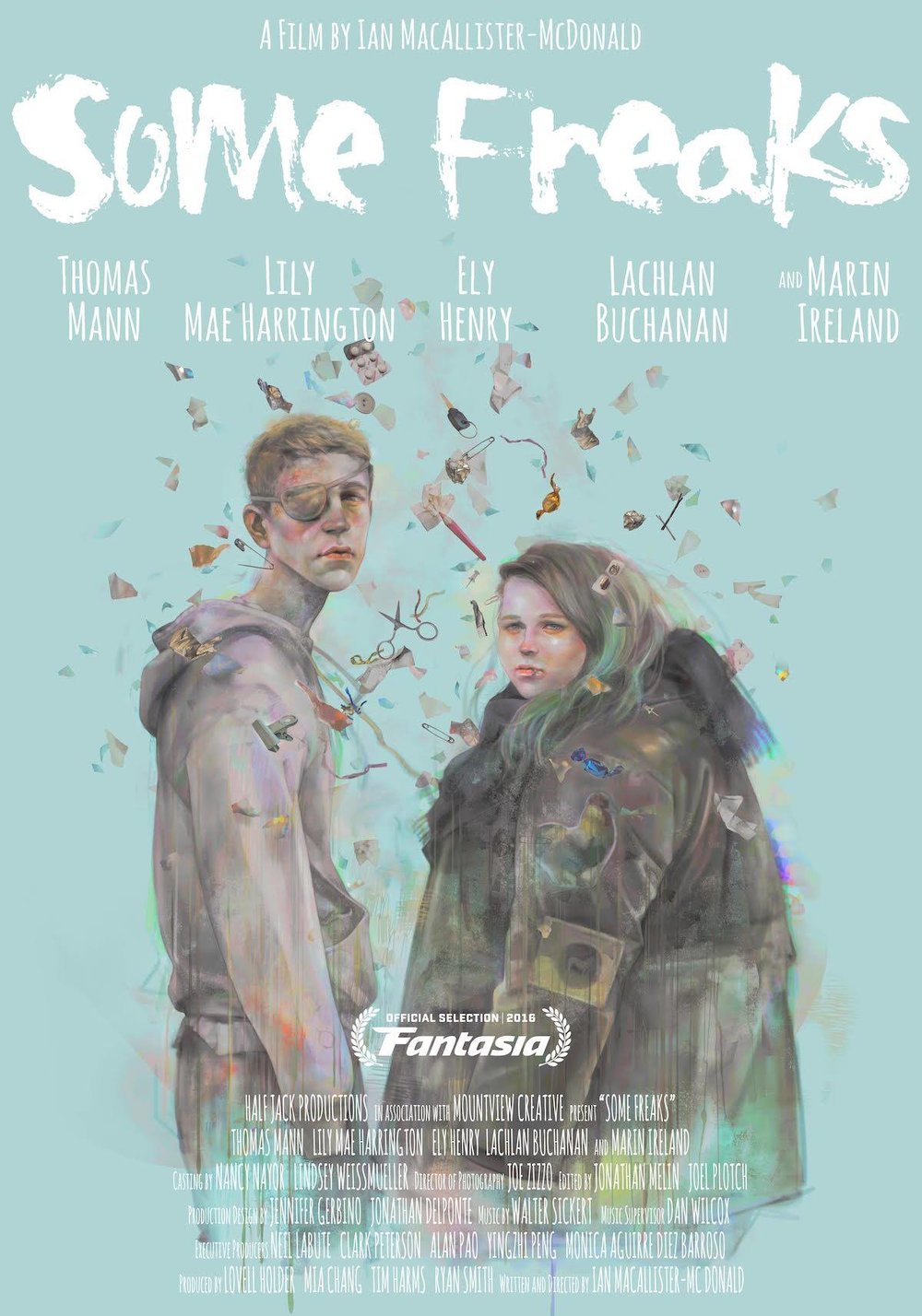
Some Freaks

(USA 2016)

A line from an old Billy Idol song (“Hole in the Wall”) appropriately sums up the plot of playwright Ian MacAllister-McDonald’s charming and touching debut feature film Some Freaks:

“We were such an ugly pair,
The chameleon twins they’d stop and stare.
Lovers know when love has gone.
A black hole there where love was once the end.”

Rhode Island high school senior Matt Ledbetter (Thomas Mann), who has the unflattering nickname “Cyclops” because of the patch he wears over his fucked up eye, doesn’t fit in with his classmates. Awkward and unpopular and literally a freak, his only friend is schlubby neo-maxi-zoom-dweebie gay motormouth Elmo (Ely Henry), who seems eager to blow just about any guy—not that any guy is ever going to let him. Lucky Matt gets to hear all of Elmo’s fantasies in graphic detail as they play video games. Yipee.

A chubby new girl (Lily Mae Harrington) in thrift store clothes and green-streaked hair flirts with Matt in biology class. Matt doesn’t know what to make of her, but he’s obviously intrigued even though he’s all shy about it. She turns out to be Elmo’s cousin Jill, who’s staying with his family for the school year after some trouble at home in Oregon.

Jill and Matt get off to a rocky start when she overhears him crack a fat joke about her to Elmo. Despite her tough facade, cynical and insecure Jill is forgiving—she has no choice because she has a thing for Matt. The three of them start hanging out. To Elmo’s dismay, Matt and Jill fall for each other and start dating.

WARNING: Potential spoilers ahead!

The end of high school brings about a quandary neither starcrossed lover anticipated. Jill gets into college out West, leaving Matt behind on the East Coast. Thus begins their long distance relationship. They lead separate lives and make similar changes without telling each other: Matt gets a glass eye and starts working out while Jill gets a new wardrobe and goes on a diet. Suddenly normalized, Matt goes to a party and hits on chicks while Jill attracts the attention of frat boy hottie Patrick (Lachlan Buchanan), who went to high school with her. His mean girl pals were not very nice.

Matt and Jill’s metamorphoses clash when he visits her six months later and they discover that their natural connection is now strained and forced. What’s worse, they bring out something ugly in each other. Is this the death knell for their relationship?

Written and directed by MacAllister-McDonald, Some Freaks is impressive even with its flaws, especially for a first time full length feature. The story and the characters recall John Hughes and Todd Solondz, but this is by no means mere imitation or an update of either. I like MacAllister-McDonald’s straightforward and unsentimental view. Yes, much of what happens here is predictable; however, there are enough twists that I didn’t see coming to keep it interesting if not fresh. The actors put a lot of heart into their characters, and it shows—even Buchanan, whose Patrick is underdeveloped and not entirely believable.

I happened to see Some Freaks on April Fool’s Day with my teenage nephew. All things considered, I couldn’t have planned it better.

With Marin Ireland, John Thorsen, Sylvia Kates, Devon Caraway, Brian Semel, Nikki Massoud, Stephen Thorne, Shannon Hartman

Production: Half Jack Productions, Mountview Creative

Distribution: Good Deed Entertainment

Screening followed by a live Q and A with Ian MacAllister-McDonald, Lily Mae Harrington, and Ely Henry

97 minutes
Not rated

(Tower City Cinemas) B

Cleveland International Film Festival

http://www.somefreaksthemovie.com

Center of My World [Die Mitte der Welt]

(Germany 2016)

Center of My World, director/screenwriter Jakob M. Erwa’s adaptation of German author Andreas Steinhöfel’s 1998 novel for young adults, is not a home run. Fortunately, though, Erwa knows how to extract enough charm, particularly from its two main actors, to downplay its shortcomings and proffer a respectable and enjoyable film.

17-year-old Phil (Louis Hofmann) lives with his mercurial, flighty mother, Glass (Sabine Timoteo), and his twin sister, Dianne (Ada Philine Stappenbeck), in a gorgeous house on the outskirts of town. This family isn’t exactly The Brady Bunch: Phil is gay, Dianne supposedly communicates with animals, and Glass can’t commit to a partner for very long. She won’t even tell her kids who their father is.

Phil notices some friction between the women of the house after he returns from summer camp. When school starts, his best friend, Kat (Svenja Jung), encourages him to go after mysterious new guy Nicholas (Jannik Schümann), a dreamy transfer student who looks like a cuter blue-eyed version of Lance Bass with his chiseled cheeks, luscious lips, and perfect hair. Supposedly, he likes boys. Phil finds out for sure in the locker room one afternoon—and it leads to a passionate affair, insecurity, and a weird bout of jealous competition with Kat.

Center of My World is a cute and engaging story. Erwa does a nice job showing how any kid, gay or otherwise, has a lot to deal with when it comes to sexuality. The Chaun Ngo’s cinematography is well done, employing a bright color pallette verging on artificial that plays really well against the small town setting with all its gardens and summer greenery. The acting is generally good. Schümann is really easy to just…gaze upon, I guess, but in a harmless Teen Beat way.

All that said, Center of My World would have been a much gutsier film, say, 15 years ago. It probably would have made a bigger impact then, too. It contains hints and echoes of things I’ve seen before. The characters are a bit hollow; some of them come off as half-baked, rendering their importance to the story tenuous or questionable. These two boys have sex a lot, which is great. However, the sex scenes here need work even with the full frontal we get. More in-your-face than sexy, they come off as gratuitous. I don’t know if Erwa was trying to be shocking, but it didn’t work if he was. It’s like watching two puppies go at it. I hope that’s not the intended result.

With Inka Friedrich, Sascha Alexander Geršak, Thomas Goritzki, Nina Proll, Clemens Rehbein

Production: Neue Schönhauser Filmproduktion, Prisma Film, Universum Film, mojo:pictures, Westdeutscher Rundfunk, Bayerischer Rundfunk, ARTE, Österreichischer Rundfunk

Distribution: Constantin-Film, Universum Film

115 minutes
Not rated

(Tower City Cinemas) B-

Cleveland International Film Festival

http://mitte-der-welt-film.de

https://www.facebook.com/diemittederwelt.film

You’re Killing Me Susana [Me estás matando Susana]

(Mexico 2016)

When I was a kid, Cedar Point would start hyping its newest ride, usually but not always a roller coaster, just as winter gave over to spring. In June, we’d finally get to the park and wait in line for two hours to experience it. Some years, the ride didn’t live up to its promise; I felt I had been duped. I recently felt that same disappointment again leaving the theater after a sold out screening of Roberto Sneider’s edgy new romantic comedy You’re Killing Me Susana.

Self-absorbed lout Eligio (Gael García Bernal) is a minor soap opera actor who believes in monogamy—for his wife, Susana (Verónica Echegui), not him. He stays out drinking, cheats on her, and sometimes drags his thespian friends over to their apartment to party into the wee hours—after Susana’s gone to bed. The look on her face and the way she pushes him off of her when he stumbles into bed and nuzzles her to cuddle is sublimely bitchy—and funny.

Eligio is the only one who’s confused when Susana leaves him. He schleps from Mexico City to Iowa to track her down, enduring American customs agents and evading campus police. He finds her enrolled in a writing program for foreign students at an unnamed university (University of Iowa, perhaps?). She’s also running around with a silent, brooding, and well-endowed Polish poet (Bjorn Hlynur Haraldsson). Without a plan or a place to stay, Eligio moves into Susana’s dorm—ostensibly to work out their issues.

Adapted by Sneider and Luis Cámara from José Agustín’s novel, You’re Killing Me Susana depicts a dysfunctional relationship that both participants take a lax approach to maintaining. I don’t mind dislikable characters, but I had some difficulty connecting with these ones. They seem to recognize a problem, but it doesn’t come off as dire. Some of what happens between them is confusing, and as a result the message gets lost. Somewhere in here, I suspect, are statements about machismo, maturity, fidelity, how men and women view sex, and what they want out of life.

The previews suggested something riotously fun and sexy, and I really like Bernal. You’re Killing Me Susana exudes that distinct cuteness with a dark undertone you see a lot in Mexican films. Overall, though, this is just okay. It has some funny moments—most of them in the trailer—but the execution is shallow, simplistic, and forgettable. Too bad, because this could have been a really powerful and interesting film.

With Ashley Grace, Andrés Almeida, Jadyn Wong, Adam Hurtig, Barbara Garrick, Ilse Salas

Production: Cuévano Films, La Banda Films

Distribution: Hola Mexico Distribution

100 minutes
Not rated

(Gene Siskel Film Center) C-

http://holamexicoff.com/susana/

https://www.facebook.com/killingmesusana/

Toni Erdmann

(Germany/Austria 2016)

Toni Erdmann is not a real person; he’s the alterego of retired divorced schoolteacher Winfried Conradi (Peter Simonischek). When Winfried, a weird old hippy jokester, appears onscreen in a shaggy wig and bad fake teeth, he certainly gives the impression that those around him have to excuse his relatively harmless but tiresome—and often annoying—penchant for silliness. He is caretaker of his elderly mother, and death surrounds him. Perhaps that explains it.

Winfried’s daughter, Ines (Sandra Hüller), a young corporate sellout working on a project in Romania, drops by for a birthday. She’s on her phone most of the time, distracted by work. She’s so serious—and severe. Predictably, she doesn’t stick around long.

When his dog dies, Winfried flies to Bucharest and stalks Ines in the lobby of the office building where she works. She sees him and takes him to a reception, where she networks with Henneberg (Michael Wittenborn), an oil company executive she wants to make a deal with. The weekend is bizarre, filled with small talk, blank stares, and uncomfortable silence. Ines doesn’t bother to pretend she’s happy to see her father; in fact, it’s pretty clear she’s relieved to see him leave.

This is where Toni Erdmann gets interesting: Winfried doesn’t actually leave. Instead, he becomes “Toni Erdmann, life coach,” and sets out to reach Ines through her professional contacts. Funny thing: it actually works.

Writer/director Maren Ade has a solid grasp of strained relationships and embarrassing situations, and a sick sense of humor to boot. It’s a winning combination in Toni Erdmann, which has its share of quite a few awesomely cringeworthy moments. Your goofy dad upstaging you at a networking opportunity? Check. Naked birthday party—with coworkers? Check. An Easter party that includes an apoplectic performance of Whitney Houston’s “Greatest Love of All”? Check. A cum-soaked petit fours? Um, check.

For all its distance, Toni Erdmann turns out to be a surprisingly emotional film. It takes nearly three hours to get to it, but it ends on a whallop. It’s touching in a way I didn’t see coming. The final scene offers all anyone needs to see about this dysfunctional father/daughter relationship. And it’s beautiful.

With Ingrid Bisu, Lucy Russell, Thomas Loibl, Trystan Pütter, Hadewych Minis, Vlad Ivanov, Victoria Cocias

Production: Komplizen Film, coop99 filmproduktion, KNM, Missing Link Films, SWR/WDR/Arte

Distribution: NFP Marketing & Distribution (Germany), Soda Pictures (United Kingdom), Enfilade (Austria), Sony Pictures Classics (USA)

162 minutes
Rated R

(Music Box) B-

http://www.komplizen-film.de/e/toni-erdmann.html

http://www.sonyclassics.com/tonierdmann/

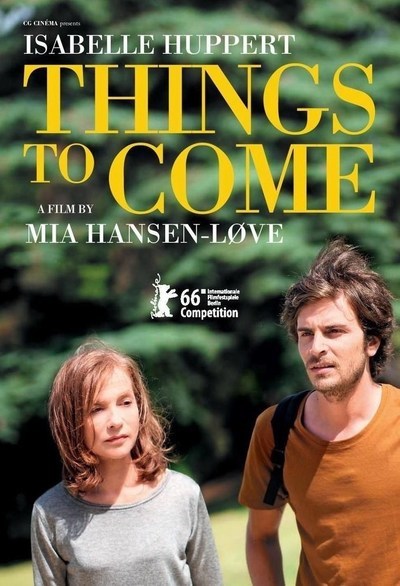
Things to Come [L’avenir]

(France/Germany 2016)

“My life isn’t over. Deep down, I was prepared. I’m lucky to be fulfilled intellectually.”

—Nathalie

A line from Talking Heads’ song “Once in a Lifetime” is apt to describe the root of the dramatic tension in Mia Hansen-Løve’s latest film: “Well, how did I get here?” Things to Come is a character study of Nathalie Chazeaux (Isabelle Huppert), a philosophy professor at an unnamed Paris university, as she navigates and reinvents her place in the world after her bourgeois examined life suddenly transforms into something else and leaves her floundering in the process.

Nathalie’s passion for her work is clear beyond her career: her husband of 25 years, Heinz (André Marcon), is also a philosophy professor; the textbook she wrote is something of a standard; and her apartment is crammed with books. Even her everyday conversation is peppered with references to philosophers, some I know and other I have never heard of. Her two adult children can follow her when she goes on about, oh, say, Plato, as she sets the table. She seems like someone who has always relied on intellect and reason.

The protesters blocking access to campus early in the film hint to something amiss; Nathalie participated in her share of protests back in the day, but this is different. Selfish, perhaps? One day, Heinz announces that he’s leaving her for another woman. “I thought you would love me forever,” Nathalie responds in a way that reads more like examining a problem than expressing surprise or hurt. Soon, her needy mother (Edith Scob) takes a turn for the worst, leaving Nathalie to figure out what to do with the cat. Meanwhile, her publisher informs her that her textbook’s future is uncertain. Then there’s the matter of her reunion with a former student, Fabien (Roman Kolinka), a cute and promising writer living in an anarchists’ commune.

Things to Come is very much about change, both in circumstances and relationships. Hansen-Løve takes a decidedly distant approach, letting us watch things unfold from afar. She’s not detached; she just seems more interested in showing the small events that shape Nathalie’s journey and letting us figure out the big picture. It works really well. Choosing “Unchained Melody” for the background in the final scene is especially clever; it’s clear about where Nathalie is on an emotional level, yet it’s open to interpretation about whether the future holds good things for her. It’s a happy, hopeful ending if you want it to be.

With Sarah Le Picard, Solal Forte, Guy-Patrick Sainderichin, Rachel Arditi, Yves Heck

Production: Arte France Cinéma, CG Cinéma, Detail Film, Rhône-Alpes Cinéma

Distribution: Les Films du Losange, Palace Films

102 minutes
Rated PG-13

(Gene Siskel Film Center) B

http://www.thingstocomefilm.com

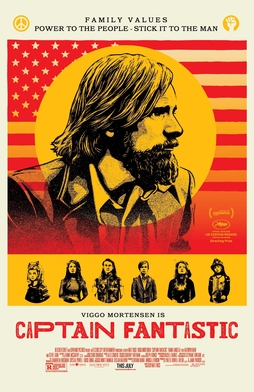
Captain Fantastic

(USA 2016)

Captain Fantastic came out last summer, and I wanted to see it then. I must confess, the cast interested me more than the plot.

Viggo Mortensen is the aptly named Ben Cash, a long disenfranchised survivalist who is, like, so over American capitalism and politics. He and his wife, Leslie (Trin Miller), shown almost entirely in flashback, decide to raise their six kids—three boys and three girls—off the grid in the mountain wilderness of Washington State. Removed from society, Ben and Leslie teach their kids everything from logic and philosophy to hunting and gathering to Norman Mailer and Guns ‘n’ Roses. They do it all without iPhones or religion. Kudos to that!

Nothing is perfect: Leslie suddenly dies, forcing Ben to take his feral kids into the outside 21st Century world for the first time, ever—which calls everything they planned for their family into question.

Director and screenwriter Matt Ross poses some interesting questions about society, conformity, and the social contract in a provocative and often lighthearted way. However, Captain Fantastic is not terribly surprising, which is why it doesn’t work as well as it could. At heart, it’s a standard fish out of water dramedy. Frankly, I spotted every “twist” coming before it got to me: the cop (Rex Young) who pulls over their Partridge Family van, the mildly blasphemous excuse that saves the day, the family’s visit to the supermarket, their reaction to their extended family (and vice versa), that lame scene in which Ben’s sister-in-law (Kathryn Hahn) calls him out onto the carpet for his choices and his youngest daughter (Shree Crooks) recites the Constitution to prove her wrong, eldest son Bo (George MacKay) proposing to the first girl who gives him attention—a trailer park teen queen (Erin Moriarty)—and the colleges he manages to get into, the “situation” that requires modern medical attention. Meh.

For all its grandiose intentions to take on the establishment, Captain Fantastic actually relies on a rather orthodox and pedestrian approach to make its point. Maybe that is its point, that you can’t escape society. It doesn’t mater: this story is predictable and sentimental, two things that never bode well. I expected more than Spokane Swiss Family Brady Bunch, which is essentially what this is. The one thing that saves this film from total mediocrity is the acting, which is great all around.

With Frank Langella, Ann Dowd, Samantha Isler, Annalise Basso, Nicholas Hamilton, Charlie Shotwell, Steve Zahn, Elijah Stevenson, Teddy Van Ee

Production: Electric City Entertainment, ShivHans Pictures

Distribution: Bleecker Street, Universal Pictures

118 minutes
Rated R

(iTunes rental) C

http://www.bleeckerstreetmedia.com/captainfantastic

Elle

(France 2016)

Director Paul Verhoeven’s Elle doesn’t sound like a comedy: the central event of the film is a rape—a bloody, violent one at that. In fact, it’s the very first scene. Strangely, the opening credits warn us that what we are seeing is “a French comedy.” Really? I guess that explains it!

Michèle Leblanc (Isabelle Huppert) is raped in her dining room by a man in a ski mask while her green-eyed cat watches, detached and seemingly bored. China is smashed, furniture is toppled, blood is shed. After he leaves, Michèle cleans up the mess and resumes her life, ordering sushi delivery—a “holiday roll,” no less.

As the film proceeds, we learn a lot about Michèle. She’s the daughter of a famous mass murderer approaching parole. She’s a ballbusting owner of a video game company. Her staff, entirely young and male, either wants to sleep with her or murder her. Her son, Vincent (Jonas Bloquet), is totally whipped by a shrew (Alice Isaaz) who’s pregnant with a baby that clearly isn’t his. Her ex-husband (Charles Berling) is involved with a younger yoga instructor (Vimala Pons). Her mother (Judith Magre) is a high maintenance piece of work who carries on with men a third her age. Meanwhile, Michèle is having an affair with with Robert (Christian Berkel), the husband of her business partner (Anne Consigny).

Things get dicey when Michèle develops a thing for her neighbor, Patrick (Laurent Lafitte), a handsome banker married to a devout Catholic (Virginie Efira) who apparently won’t fuck him. Their flirtation messes with her head as she tries to figure out who raped her. She’s surrounded by men, and every one of them is suspect.

David Birke’s screen adaption of Philippe Djian’s novel Oh… is, in a word, warped. Elle plays with power, desire, sex, and of all things sympathy. Consistent with its character—a constant switcheroo you don’t know whether to trust or look away from—it’s not a sad affair. To the contrary, it’s daring, thrilling, irreverent, and totally fun. It shouldn’t work—I found myself questioning whether I should enjoy the film as much as I did—but it does. The execution of both the plot and the characters is clever—and Stéphane Fontaine’s cinematography, which nicely illustrates the psychological drama here, is flawless. If nothing else, Elle is a visually stunning film.

Iggy Pop’s “Lust for Life” plays at various points in Elle, suggesting a lot of contradictory things. I took it as ironic more than anything. Elle is not for everyone, but it’s a powerful statement for those who can handle it—the perfect film for Valentine’s Day.

With Lucas Prisor, Raphaël Lenglet, Arthur Mazet, Hugo Conzelmann

Production: SBS Productions, Pallas Film, France 2 Cinéma, Entre Chien et Loup, Canal+, France Télévisions, Orange Cinéma Séries, Casa Kafka Pictures, Proximus, Centre National de la Cinématographie, Filmförderungsanstalt

Distribution: SBS Distribution

130 minutes
Rated R

(Gene Siskel Film Center) B+

http://sonyclassics.com/elle/

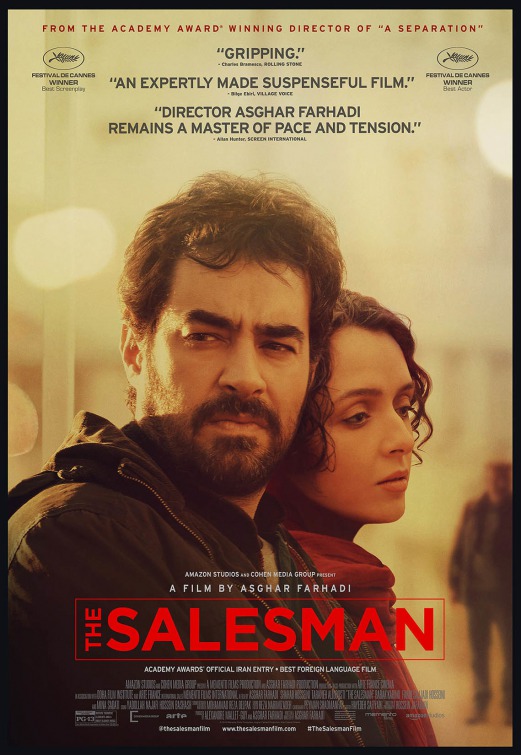
The Salesman [Forušande]

(Iran 2016)

Asghar Farhadi’s The Salesman [Forušande] [فروشنده] is a marvelously dark and brooding study of a married couple that shifts smoothly from a domestic crisis drama to a revenge flick. His approach is a lot more subtle than one an American director might take, but this is precisely what makes The Salesman so satisfying.

While working out the finishing touches of a production of Arthur Miller’s Death of a Salesman in which they play the Lomans, community actors Emad (Shahab Hosseini) and Rana (Taraneh Alidoosti) are forced out of their apartment just days before the play opens when a construction mishap next door weakens the building’s foundation. The cracks in the walls become a metaphor for what’s about to happen to their relatively peaceful marriage.

A fellow cast member, Babak (Babak Karimi), sets them up in temporary digs, a recently and hastily vacated apartment that still contains the previous tenant’s belongings: furniture, bedding, dresses, tons of high heel shoes, a kid’s bike. One night when she’s home alone, a stranger attacks Rana in the shower. She can’t identify him, and she doesn’t want to go to the police. She won’t even say exactly what happened.

Rana starts to go off the deep end; the more unsafe she feels, the less secure Emad is in his own ego. He stews as he pieces together what might have transpired. A set of keys and a delivery truck parked on the street seems like a promising lead to tracking down the stranger, which becomes something of an obsession for Emad.

Farhadi has a straightforward, minimal style. Although he draws a few parallels to Death of a Salesman, he doesn’t beat us over the head with them. He does a nice job dropping us into the story and letting us figure out what he’s getting at. He has a lot to say about male aggression, turning the tables from Rana as the victim to Emad—his masculinity takes a beating as the film progresses.

With Farid Sajadhosseini, Mina Sadati, Mojtaba Pirzadeh

Production: Memento Films Production, Asghar Farhadi Production, Arte France Cinéma

Distribution: Amazon Studios (USA), Cohen Media Group (USA), Filmiran (Iran), Memento Films Distribution (France)

125 minutes
Rated PG-13

(Regal Webster Place) B+

http://www.thesalesmanfilm.com/showtimes

http://cohenmedia.net/films/the-salesman

Julieta

(Spain 2016)

Pedro Almodóvar has his own voice and his own vision, and he’s stayed true to both from the beginnning of his career. He’s an incredible story teller with no shortage of stories to tell; in fact, he once said that he “can make a thousand different movies about the same subject” (https://www.brainyquote.com/quotes/quotes/p/pedroalmod587571.html). His frank treatment of sexuality is as bold as his visual style, and his characters are all memorable. His plots are intricate, loaded with twists and turns and weird things that throw in a wrench that takes the whole thing somewhere you never saw coming. He’s a master of exaggeration—it works just as well in his comedy as it does in his melodrama.

Julieta, Almodóvar’s current film—his twentieth feature—is no exception. Like most of his movies, particularly his post-millennial work, this one centers on women. Inspired by three short stories (“Chance”, “Soon,” and “Silence”) from from Alice Munro’s 2004 book Runaway, Julieta is, in simplest terms, the story of one woman’s search for her estranged daughter. There’s a lot more to it, of course, and Almodóvar slowly reveals it all, layer by layer.

Julieta (Emma Suárez) is a middle-aged woman who lives in Madrid with her boyfriend, Lorenzo (Darío Grandinetti). They’re packing to move to Portugal. Julieta has a secret: she has a daughter, Antiá, who checked out of her life more than a decade ago. She happens to run into Beatriz (Michelle Jenner), an old friend of Antiá, on the street. Beatriz gives Julieta some small information about Antiá, prompting Julieta to drop all plans in the hope of her daughter returning. She begins writing a journal, which turns into a flashback that tells us what happened.

Some 30 years before, young Julieta (Adriana Ugarte) meets scruffy fisherman Xoan (Daniel Grao) on a train. He’s married, but his wife is in a coma. He knocks up Julieta, who receives a letter from him and visits him at his home in a small Spanish fishing town. They decide to raise Antiá together there. When Antiá (Priscilla Delgado) is a teen and away at camp, Julieta and Xoan have a fight that leads to disaster. Julieta doesn’t tell Antiá everything, and it comes back to bite her.

Nothing by Almodóvar ever sucks, but I’ve found his work to be up and down after All About My Mother. It’s to be expected from an artist with a long career, Madonna being a good example. His last project, 2013’s I’m So Excited, was fun but certainly not his most compelling. Julieta, however, is solid—I say it’s his finest hour and a half since Volver. It’s not a light film—it’s an elegant, emotional slow burner that deals with regret, omission, and forgiveness. Ugarte and Grao are both hot, and they have a palpable chemistry. Casting Rossy De Palma as Xoan’s longtime passive-aggressive housekeeper is a nice touch.

With Inma Cuesta, Blanca Parés, Pilar Castro, Tomás del Estal

Production: El Deseo

Distribution: Warner Brothers (Spain), Pathé, 20th Century Fox

99 minutes
Rated R

(AMC River East) B+

http://sonyclassics.com/julieta/

Hacksaw Ridge

(USA/Australia 2016)

“Thou shalt not kill.”

—The Ten Commandments


“I don’t know how I’m gonna live with myself if I don’t stay true to what I believe.”

—Desmond Doss

Like him or not, Mel Gibson has what it takes to direct a massive Hollywood picture. Hacksaw Ridge, his first directorial job in a decade, demonstrates that much—just in case earlier films like Braveheart, The Passion of the Christ, and Apocalypto didn’t.

Hacksaw Ridge depicts the remarkable and true story of Desmond Doss (Andrew Garfield), the Lynchburg, Virginia, Seventh-day Adventist who served as a medic in the U.S. Army during World War II. His story is unique: he enlisted, but as a conscientous objector for religious reasons. Refusing to kill or carry a gun, he rescued 75 or so wounded soldiers from the field during the Battle of Okinawa (http://www.collegedale-americanlegion.org/Pages/DesmondTDoss.aspx). President Harry S. Truman awarded Doss the Congressional Medal of Honor in 1945, the first time such a high accolade was bestowed upon someone who never even discharged a weapon (https://en.wikipedia.org/wiki/Desmond_Doss).

From a technical standpoint, Hacksaw Ridge is pretty awesome. The story is a good one. The battle scenes are clearly the centerpiece: they’re loud and extremely graphic. The prosthetics are spot on realistic. Cinematographer Simon Duggan starts out with warm, almost sepia tones in the early civilian scenes, but as the setting moves onto the battlefield he ditches color in favor of a washed out black, green, and white palette. Shaky closeups, slow motion shots, blurry pans, and quick cuts create a sense of confusion as gunfire and explosions and human carnage take over the screen. Hacksaw Ridge is no Son of Saul (https://moviebloke.com/2016/02/11/son-of-saul-saul-fia/), but it still overwhelms the senses albeit in a distanced, staged blockbuster way.

Otherwise, Hacksaw Ridge didn’t impress me all that much. At its core, it’s a standard-issue war movie complete with a sugary subplot about the girl, Dorothy Schutte (Teresa Palmer), waiting for Doss to hurry up and get back home so they can get married, and lots of humorous if mawkish male bonding through nicknames, insults, physical attacks, and simply having each other’s back. There’s a military court scene, trite “war is hell, boys” lines, soldiers who freak out once they get on the battlefield, likable characters who perish, and of course the superhuman heroic deeds of Doss.

Most character background is given hurried and superficial treatment: Doss’s alcoholic veteran father (Hugo Weaving) and his bad experience in World War I, Doss and Dorothy’s quick courtship, even the failed attempts of Sgt. Howell (Vince Vaughn) and Cpt. Glover (Sam Worthington) to persuade Doss to leave the Army. Too bad, because a little more insight could have made the film stronger. A particularly glaring example is brother Hal (Nathaniel Buzolic), who simply vanishes once he shows up at the dinner table in uniform. What happens to him? Did I miss it?

I’m conflcited on the message here, but I guess that’s okay because frankly Hacksaw Ridge is a conflicted film. Gibson maintains that it’s an anti-war statement (http://www.christianpost.com/news/mel-gibson-hacksaw-ridge-is-an-anti-war-movie-170318/). Fine, but that’s hard to believe considering the disproportionate amount of time and resources given to overblown battle scenes. I’m not sure the film honors Doss or his pacifist convictions. Moreover, what sure seems like a blatant parallel to the so-called religious liberty movement is, in my view, misguided and hollow, especially when Doss’s faith is treated more or less as incidental. Hacksaw Ridge sustained my interest, but I would have appreciated a little more depth.

With Luke Bracey, Darcy Bryce, Rachel Griffiths, Firass Dirani, Michael Sheasby, Luke Pegler, Nico Cortez, Goran D. Kleut, Harry Greenwood, Damien Thomlinson, Ben O’Toole

Production: Pandemonium Films, Permut Productions, Vendian Entertainment, Kylin Pictures

Distribution: Summit Entertainment (USA)

139 minutes
Rated R

(ArcLight) C+

http://www.hacksawridge.movie