Florence Foster Jenkins

(UK 2016)

“People can say I can’t sing, but they can’t say I didn’t sing.”

—Florence Foster Jenkins

A lot of hype surrounded Florence Foster Jenkins before it arrived at a theater near us last fall. We wanted to catch it during its original run, but it came and went before we got around to seeing it. So, inspired by a post earlier in the day, I rented it on a Friday when we had no plans other than dinner at home. The night we watched it just happened to be Friday the 13th, which somehow seems appropriate.

Based on actual events and set during WWII, Florence (Meryl Streep) is a rich Manhattan society lady of a certain age who runs in an arty circle and knows a lot of people, some with money and others who follow it. She operates a private venue dedicated to opera, the Verdi Club, where she stars in a show and has a non-speaking role. Dying of either syphillis or the treatment for it—mercury and arsenic!—her one wish is to perform for an audience at Carnegie Hall. The problem is, she can’t sing; she’s downright awful. Her entrance here, lowered onstage from a rope and pulley while dressed as an angel with a harp, reminds me of Sarah Jessica Parker’s entrance (“I offer you mortals the bird of peace so that you may change your ways and end this destruction”) in Ed Wood, Tim Burton’s 1994 biopic about a similarly talentless film director who came along a decade or so later. The comparison is so apt that I wonder if it was intentional. Here, Florence’s husband, St. Clair Bayfield (Hugh Grant), doesn’t help matters by exaggerating her talent.

Determined to make her dream come true, Florence hires a vocal trainer, Carlo Edwards (David Haig), and a pianist, Cosmé McMoon (Simon Helberg), to put together a show. Established and well-known Carlo is content to take Florence’s money, build her ego, and let her dream on. Budding Cosmé, however, struggles with lying to her about her obvious ineptitude, not to mention her negative impact on his professional reputation. He soon sees that those around Florence stretch the truth about a lot of things when dealing with her.

Nicholas Martin’s script is kind to its characters, going for laughs in a way that doesn’t demean any of them. I never heard of her until this film, but the actual Florence Foster Jenkins was an interesting person. Her singing truly was awful:
https://www.youtube.com/watch?v=Hcs9yJjVecs. As always, Streep is spot on with her portrayal. She seems to have fun in this role, and it shows. Grant, who usually bores me but doesn’t here, is well suited for St. Clair: he’s stuffy and straight, but he nicely coveys an underlying deceitfulness that doesn’t come off as sinister. I like the way director Stephen Frears plays with deceit here, ultimately using it to depict a very touching side of St. Clair—who lives with his mistress (Rebecca Ferguson) in Brooklyn in apartment that Florence pays for. Much to my surprise, though, Big Bang Theory‘s Helberg steals practically every scene he’s in: keeping it subtle with Cosmé’s homosexuality (as Cosmé himself no doubt would have done during his day), he plays his character as a spineless, perennially uncomfortable, asexual bundle of nerves. He peppers his performance with grimaces and nervous giggles. Later, he delivers a line to explain his tardiness to Florence (of course, it involves sailors) with perfect and priceless dryness. He outshines everyone here.

Florence Foster Jenkins has some funny moments and some very touching ones. I found it enjoyable enough, but certainly not a knockout. It could have benefitted from a little more quirk and edge, especially considering its title character who showed no shortage of either.

Also starring Nina Arianda, Stanley Townsend, Allan Corduner, John Sessions, John Kavanagh, David Menkin, and Sid Phoenix

Produced by Qwerty Films, Pathé Pictures International, and BBC Films

Distributed by Paramount Pictures (USA)

111 minutes
Rated PG-13

(iTunes rental) C

http://www.florencefosterjenkinsmovie.com

Silence

(USA 2016)

“I pray but I am lost. Am I just praying to silence?”

—Fr. Rodrigues

Just as main character Fr. Rodrigues (Andrew Garfield) is conflicted about his faith, I’m conflicted about Martin Scorsese’s current project, Silence. This film is clearly a labor of love and something extremely personal, both of which I greatly respect. Its genesis dates back nearly 30 years to the controversial The Last Temptation of Christ—can there be a more fitting starting point?—when Scorsese read Shusaku Endo’s novel (the title is the same as the movie) about Jesuit missionaries and Catholicism in Japan in the 17th Century (http://mobile.nytimes.com/2016/11/27/magazine/the-passion-of-martin-scorsese.html?_r=0&referer=https://www.theatlantic.com/entertainment/archive/2016/12/martin-scorsese-silence-theology-art-jesuits/510827/ ). Having a Jesuit education myself, the nuance of what drives the characters (i.e., the service-oriented “men for others” philosophy of the Society of Jesus and the desire to make the right decisions and find answers) is not lost on me.

Momentary diversion: I was simultaneously amused and wowed by the number of nuns and priests in attendance at the pre-opening screening that I attended. I say “amused” because the audience looked like a Catholic J. Crew catalog; and I say “wowed” because the turnout served as a testament to the weight of this film. I felt it, and it was heavy. Credible. Plus, what does it say that a lapsed Catholic like me shows up for the pre-opening screening of a religious film as if it were a release party for a new Madonna album? More conflict.

But I digress. Silence follows two Portuguese Jesuit priests—the aforementioned Fr. Rodrigues and Fr. Garrpe (Adam Driver)—on their search to find their spiritual teacher and mentor, Fr. Ferreira (Liam Neeson), who has gone missing in Japan. The Japanese state has banned Christianity: those who practice it are hunted down by a committee, tortured, and killed. There’s an easy way out, weird as it is, that involves stepping on Catholic icons. Unsettling rumors have come to light concerning Fr. Ferreira, the most troubling of which is that he renounced Catholicism.

Silence is a gorgeous film—Rodrigo Prieto’s cinematography is breathtaking. I can feel every fly and bead of sweat I see on the screen. The idea of pushing “What Would Jesus Do?” to its mindfucking extreme is absolutely brilliant. The acting is generally flawless, but Issei Ogata easily shines lightyears beyond everyone else as the surprisingly unarresting, pragmatic, and understanding Inquisitor. Scorcese does a beautiful job demonstrating two timely ideas: tolerance is crucial for any civilized society, and doubt is totally normal. Can I get an amen? All that said, however, Silence is gratuitous in length, tedious, and exhausting. Painfully boring at points, even. The narration drove me crazy after awhile, as did the subpar Portugese accents. The ending is emotionally brutal; it’s ultimately satisfying, but you have to look closely and you have to be thinking. Normally, this wouldn’t be something worth mentioning; but at the end of such an energy zapper as Silence, it’s just not what I was prepared to do. I love what Scorcese gets at here; he does it artfully for sure, but I wish he had gone about it in a more direct and interesting way.

Also starring Ciarán Hinds, Shin’ya Tsukamoto, and Yôsuke Kubozuka.

Produced by Sharpsword Films, AI Film, CatchPlay, IM Global, Verdi Productions, YLK Sikella, and Fábrica de Cine

Distributed by Paramount Pictures

161 minutes
Rated R

(AMC River East) C+

http://www.silencemovie.com

Paterson

(USA 2016)

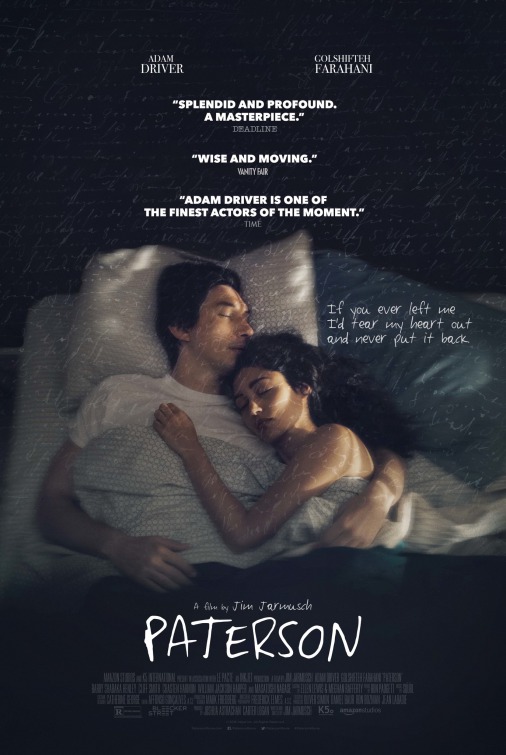
Not a lot happens in Jim Jarmusch’s new film Paterson—it is, to borrow from Seinfeld, a show about nothing. Starting on a random Monday, the story follows Paterson (Adam Driver)—a Paterson, New Jersey, city bus driver and closet (or in this case, basement) poet—through his daily routine for a whole week. He finds inspiration in the simplest things: passengers, barflies, Ohio Blue Tip matches. He works it all into his “secret notebook” of poetry, scribbled in sidebars onscreen. Some of it is interesting, some not so much.

Jarmusch throws a lot out there: never mind the recurring parallels between Paterson and those he encounters—there’s imagery of twins, waterfalls, circles, and fireballs. Attempting to infer a weighty point in all of it, though, is probably an exercise in futility; this is fluid stream of consciousness. The story is more a string of vignettes: Paterson’s wife, Laura (Golshifteh Farahani), orders a guitar online and later serves Brussels sprout and cheddar pie for dinner; the bus Paterson drives breaks down; a situation arises in the bar where Paterson has a beer every night when he walks his wife’s dog, Marvin (Nellie, who, sadly, passed away before Paterson came out: http://www.indiewire.com/2016/05/the-2016-palm-dog-posthumously-awarded-to-nellie-the-dog-from-jim-jarmuschs-paterson-289094/).

The characters Paterson encounters are plentiful and colorful: defeatist coworker Donny (Rizwan Manji); a rapper (Method Man) in a laundromat; a young poet (Sterling Jerins) waiting for her mother in the bus yard; Marie (Chasten Harmon) and her sensitive beau, Everett (William Jackson Harper), whom she’s trying to dump; a nameless gangbanger (Luis Da Silva, Jr.) who warns Paterson about dog-jacking (not that it stops him from tying Marvin to a spigot outside the bar every night); anarchists, old ladies, and braggarts on the bus.

Perhaps the most accomplished thing about Paterson is its rhythm: the plot moves slowly but in a purposely metered fashion. Cinematographer Frederick Elmes creates a dreamy and downright poetic look. The relationship between Paterson and the world has its own set of rules. This film reminds me of Dead Man, which I haven’t seen in two decades: quietly contemplating routine and rut, Paterson ultimately celebrates the poetry in the mundane. The unnamed traveler and angel (Masatoshi Nagase) at the end literally gives us the “a-ha” moment. With nearly no outside sound, not even music, I thought of one thing: if James Joyce’s Ulysses were made into a movie, it would feel a lot like this. Unlike Leopold Bloom, though, Paterson’s wife isn’t cheating on him, and no one except Marvin seems to mind his presence.

Side note: for some reason, the screening I caught included Spanish subtitles, unintentionally adding another layer of what-the-fuck. Paterson is not a movie for everyone, but I definitely see a following here. I liked it.

Also starring Barry Shabaka Henley, Trevor Parham, Troy T. Parham, Kara Hayward, Jared Gilman, Johnnie Mae.

Produced by K5 International, Le Pacte, Animal Kingdom, and Inkjet Productions

Distributed by Bleeker Street Media and Amazon Studios

118 minutes
Rated R

(Landmark Century) B-

http://www.bleeckerstreetmedia.com/paterson